Introduction and concepts
cerebro automates the process of collecting time-series data from multiple, potentially mismatched sources, and storing them in one or more services with a uniform datamodel. The SDSS use-case is to collect information from different subsystems (actors, FPS telemetry, weather data) and store it in an InfluxDB database, but it’s general enough to be used with other backends and frontends.
cerebro is strongly influenced by the concepts introduced by ReactiveX and it makes use of the Python implementation. Rx can be unnecessarily complicated for many applications, so cerebro tries to simplify the process while retaining the machinery.
While it’s not necessary to have a deep understanding of the concepts in Rx, a basic familiarity with them and with how cerebro works is recommended. The following diagram shows a simple example of use.
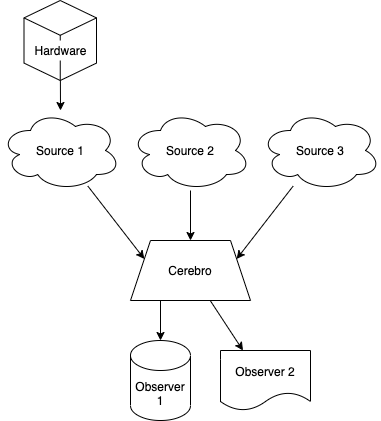
Here we see different sources of data (Sources 1 to 3), some of which may be retrieving data from a connected hardware. cerebro acts as funnel collecting the information from all the sources and then passing it to each one of the “observers”.
The following concepts are central to how cerebro works:
Sources. A source is an entity that emits data. It may be a temperature sensor, a stream of data from a message passing system, or a process that produces a series of data points. Often sources are connected or read from a piece of hardware. Sources emit data points (see below) associated with a certain time. In
cerebrosources are always instances of a givenSourceclass that defines how to access and read the data, and formats it as valid data points that are then made available tocerebro. Sources are Rx Subjects.Observers. Observers are entities that receive data from one or several sources and output or store them with a uniform datamodel Examples of observables are a time series database (e.g., InfluxDB) or a process that collects all the source data and streams it as a datagram. In
cerebroobservers are based on Rx Observers and are instances of anObserversubclass.Cerebro. An instance of
Cerebroacts as a subject and listens to all the sources running. Every time a source issues data, it makes it available to all the observers that are connected. Cerebro also handles the creation of sources and observer instances from a configuration file or command line.Data points. Sources emit data points, which are named tuples consisting of a list of data and, where relevant, a valid
bucketwhere to store the data. The data is a list of dictionaries, each dictionary representing a data point in time. Each data point consists of a measurement (a string indicating the type of data measured), a dictionarty of fields (in the format{field1: value1, field2, value2, ...}) associated with the measurement, a dictionary of keyword-value tags, and the time of the measurement. This structure is heavily inspired by the InfluxDB data structure. Data points are instances ofDataPoints.
To see practical examples of how to define data sources, observers, and data points, head to Getting started with cerebro.